
Chronic Tension Headache
The use of EMG biofeedback
for the treatment
of chronic tension headache.
- John G. Arena, Ph.D.,
Glenda M. Bruno, R.N., M.S.,
Andrew G. Brucks, M.S. - Pain Evaluation and Intervention
Program Department of Veterans Affairs Medical Center
and Medical College of Georgia Augusta, Georgia
Introduction
Headache is the most common pain complaint(11) and the most frequent medical problem seen in medical clinics(7). Most experts(3) believe that the majority of headaches are muscle tension-type. Community-based epidemiological studies have found that 14% of men and 29% of women have had headaches either every few days or headaches which significantly bothered them(9).
Tension headache is generally described as a bilateral dull ache, pressure or cap-like pain that is usually located in the forehead, neck and shoulder regions. The headache typically occurs from two to seven days a week and can last from one hour to all day; a small proportion of tension headache sufferers have continuous headache. Migraine headache, on the other hand, is described as a unilateral pain, generally accompanied with nausea and vomiting, with the pain characterized as throbbing or pulsating. Clinicians who deal with headache patients should use a standardized set of inclusion and exclusion criteria for diagnosis such as specified by the Ad Hoc Committee on the Classification of Headache(1) or the newer Ad Hoc Committee of the International Headache Society(2).
Treatment of Chronic Tension Headache
Behavioral treatments for chronic tension headache have been found to be as effective as pharmacological interventions(8). Although nearly all of the headache literature treats biofeedback and relaxation therapy as separate interventions, most clinicians combine both procedures when treating their tension headache patients.
A study by Holroyd and his colleagues(10), detected no significant difference between subjects who trained to increase or decrease their muscle tension levels; high success feedback groups showed substantially greater improvements in headache activity (53%) than low success groups (26%). This study demonstrated the importance that cognitive mediating factors such as perceived success and self efficacy play in biofeedback training, and the enhanced awareness of ones level of muscle tension during non-biofeedback periods. Thus, the emphasis on biofeedback training with tension headache should focus on skill acquisition and the therapist-patient relationship.
EMG Biofeedback Training
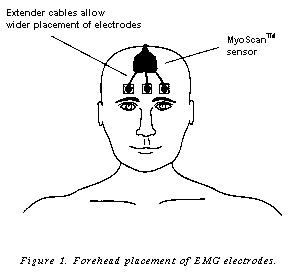
Initially, place the two active sensors approximately in the center of the forehead in line with the pupil of the respective eye. The reference (ground) sensor is placed between the two active sensors (figure 1). We recommend the use of disposable EMG sensors to insure against infection. A reading of less than 2 microvolts generally indicates a fairly relaxed muscle group. If the level starts off and remains low even during stress provoking imagery or discussion, or after the patient has gone through an adequate course of forehead EMG biofeedback and little change in headache activity is noted, advance to the shoulder and neck regions (figure 2). Palpation for muscular tenderness may also be used in the selection of electrode placement sights.
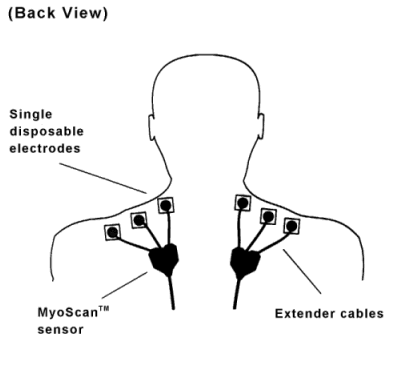
To decrease patient anxiety, refer to the electrodes as sensors, and indicate that EMG only senses electrical activity and does not send current through the body.
Settings on the MyoTrac(TM):
- Set the OFF/CONT/THR switch to continuous
- Set the gain switch to x10, or to x1 if the muscle activity is less than 10 uV.
- Set the threshold setting so that the bargraph reading is near the yellow LED.
- Set internal switches to OFF/OFF/ABV/WIDE
- For clinical use, a computerized EMG system such as the MyoDac2(TM), MyoTrac2(TM), ProComp(TM) or FlexComp/DSP(TM) provides either bargraph or polygraph displays, as well as full database functions which allow the storage of patient information and session data.
Initial Session Strategies
We say something like this: "Its traditionally been assumed that the type of headache you have - tension headache - is caused by very high levels of muscle tension in your forehead, neck and shoulder areas. These muscles have been tense for a long time. Through biofeedback training, you will learn to both be aware of and decrease your muscle tension levels at any time. When you do this, its hoped that you will get a decrease in your headaches."
We next give the patient a number of possible strategies to choose from. We emphasize that learning the biofeedback response is purely an idiosyncratic process and that what works for others may not work for them. We customarily describe 6 possible biofeedback strategies outlined in Table 1 (figure 3).
In the first session, we usually tell the patient to pick only one strategy and stick with it the entire session. We keep the initial session short - a 3-5 min. adaptation period (Just sit quietly with your eyes closed) and a maximum of 12 min. of biofeedback. (In latter sessions, we increase the biofeedback portion to a maximum of 25 min.) We emphasize that learning to relax muscles at will can be a difficult response to learn and that it may take some time before they can lower their forehead muscle tension reliably; we tell them not to get discouraged if they cannot control their EMG levels immediately. We instruct the patients to let the response occur rather than make it occur, to be passive rather than try to force their forehead muscles to relax. We let them choose which type of visual and auditory feedback they like. At the end of the biofeedback session when the sensors are removed and the sessions data is saved, we inquire as to which strategy was employed and the patients perception as to how effective it was. We also get a self report of relaxation, muscle tension and pain levels on a 1-10 scale prior to and following the session. If using a computer, we review the actual minute by minute printout of the data with the patient. Throughout this review we attempt to impart to the patient the most positive feeling of success gained, based on the realities of the sessions data. The number of sessions may run from 10 to as many as 24.
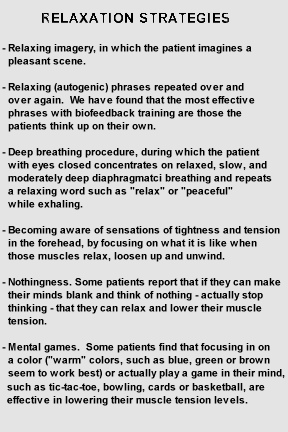
Figure 3. Table 1.
Coaching and
Therapist Attitude
The first, and most important thing for a therapist to determine about coaching, is whether a patient wants and could benefit from coaching. This is truly idiosyncratic. There are three general situations during EMG biofeedback that you have to be prepared for:
Situation 1 - The patient has decreased forehead muscle tension levels. Possible responses are:
a) Thats fantastic! Keep up the good work. I want you to remember what you are doing now so you can tell me at the end of the session. Real good! Try to get it even lower. Situation 2 - The patient has not been able to decrease forehead muscle tension levels. Possible responses are: Thats OK. Its as important to find out what makes it go up as it is to find out what makes it go down. I want you to remember what youre doing now so you can tell me at the end of the session. Thats OK. You can only go up so far before you have to start going down. You seem to be going up; you might want to switch to a different strategy. Situation 3 - The patient seems frustrated or appears to be trying too hard. Possible responses are: Thats to be expected. Remember, I told you that this is a very difficult response to get. If it was easy, you wouldnt need me or the machines. Lets take a break. Sometimes all you need is a few minutes to clear your mind and then you come back like gangbusters. You may want to think of yourself as a scientist, who dispassionately tests theories and tosses them in or out depending on whether or not they work. As a rule, we would suggest that coaching be done in a limited basis, as this will help to generalize the response to the real world, for in everyday situations patients do not have a therapist accompanying them. It is imperative for the therapist to convey as enthusiastically as possible to the patient that he or she is doing well in the biofeedback session.
Homework
Home practice has traditionally been considered an essential aspect of all psychophysiological interventions for chronic tension headache(8,12). Home practice can be conducted in many ways: The simplest form of homework is to instruct the patient to practice the office strategy that seemed to work the best at home and in other real world locations such as the job, supermarket, etc. (we usually instruct them to do so at least four times a day). The use of a home practice EMG unit, such as the MyoTrac(TM), is also quite helpful. An important application for the MyoTrac(TM) EMG is to use it in situations which generally initiate headaches. For example, computer operators might monitor muscle activity while typing, using the delayed threshold function (internal switch positions at OFF/ON/ABV/WIDE) which provides a tonal warning only when the threshold level has been exceeded for more than 4 seconds. In this way, maintained muscle tension is minimized, while appropriate low levels of muscle activity is reinforced.
Generalization
Generalization involves preparing the patient to carry the learning that may have occurred during the biofeedback session into the real world. The most common method, by far, is a self control condition which is interspersed between a baseline and a feedback condition. The self control condition involves asking the patient to control the desired psychophysiological response (e.g., "Please try to lower your forehead muscle tension") without any feedback. If the patient can control the response, the clinician may assume that there has been between-session learning (i.e., generalization). Another method of testing for generalization is to present a pre- and post-treatment stressor to the patient and, if there is less arousal during and after a stressor in the post treatment, the clinician may infer that generalization has occurred. A third way of preparing the patient to generalize the biofeedback response is to try to make the office biofeedback training as close to real world situations as possible, such as switching to an uncomfortable chair or standing during the session.
Biofeedback for tension headache in the elderly
Based upon the research (4,5,6) and our clinical experience we would suggest the following when working with the elderly tension headache patient: First, to be certain that the patient understands the therapists instructions, we would suggest requesting each patient to verbally repeat each sessions instructions. Second, therapists should talk at a somewhat slower rate than usual to insure that rationale and instructions are comprehended. Third, the therapist should make every attempt to simplify the instructions and, especially, to avoid the use of sophisticated language or jargon. Fourth, a brief summary of previously imparted information should be given at subsequent sessions to aid patients in retaining details. Fifth, turn up the biofeedback auditory feedback volume to ensure the patient can hear it, or use an earphone. We would also suggest moving the visual feedback monitor closer to ensure that the patient does not have to strain to see it. Finally, be patient with the elderly headache sufferer. Spend some extra time listening; do not communicate a desire to hurry the session. Schedule appointments for 10 minutes longer than usual.
Conclusion
A biofeedback - behavioral program to assist headache patients to decrease both the severity and frequency of headaches has been described. The program includes in-clinic training as well as the inclusion of EMG portable home trainers to provide reinforcement of behavioral and muscle control strategies in the real world.
References
- Ad Hoc Committee of the International Headache Society. Classification of headache. Journal of American Medical Association, 179, 717-718, 1988.
- Ad Hoc Committee on the Classification of Headache. Classification of headache. Journal of the American Medical Association, 179, 127-128, 1962.
- Andrasik, F. & Blanchard, E.B. Biofeedback treatment of muscle contraction headache. In Hatch, J.P., Fisher, J.G., Rugh, J.D., (eds.) Biofeedback: Studies in Clinical Efficacy. NY: Plenum Press, 1987.
- Arena, J.G., Hannah, S.L., Bruno, G.M. & Meador, K.J. Electromyographic biofeedback training for tension headache in the elderly: A prospective study. Biofeedback and Self-Regulation, 4, 379-390, 1991.
- Arena, J.G., Hannah, S.L., Bruno, G.M., Smith, J.D. & Meador, K.J. Effect of movement and position on muscle activity in tension headache sufferers during and between headaches. Journal of Psychosomatic Research, 35, 187-195, 1991.
- Arena, J.G., Hightower, N.E. & Chang, G.C. Relaxation therapy for tension headache in the elderly: A prospective study. Psychology and Aging, 3, 96-98, 1988.
- Bakal, D.A. Psychology and Health, Second Edition, Springer Publishing Company, New York, 1992.
- Blanchard, E.B. Psychological Treatment of Benign Headache Disorders. Journal of Consulting and Clinical Psychology, Vol. 60, No. 4, 537-551, 1992.
- Dupuy, H.J., Engel, A., Devine, B.K., Scanlon, J., Querec, L. Selected Symptoms of Psychological Stress, US Public Health Service Publication #1000, Series 11, #37. National Center for Health Statistics. 1977.
- Holroyd, K.A., Penzien, D.B., Hursey, K.G., Tobin, D.L., Rogers, L., Holm, J.E., Marcille, P.J., Hall, J.R. & Chila, A.G. Change Mechanisms in EMG Biofeedback Training: Cognitive Changes Underlying Improvements in Tension Headache. Journal of Consulting and Clinical Psychology, Volume 52, 1039-1053, 1984.
- Peatfield, R. Headache. New York, Springer, 1986.
- Schwartz, M.S. Biofeedback: A Practitioners Guide. New York: Guiliford Press, 1987.
Copyright, 1997 The Biofeedback Federation of Europe